
Skip to content
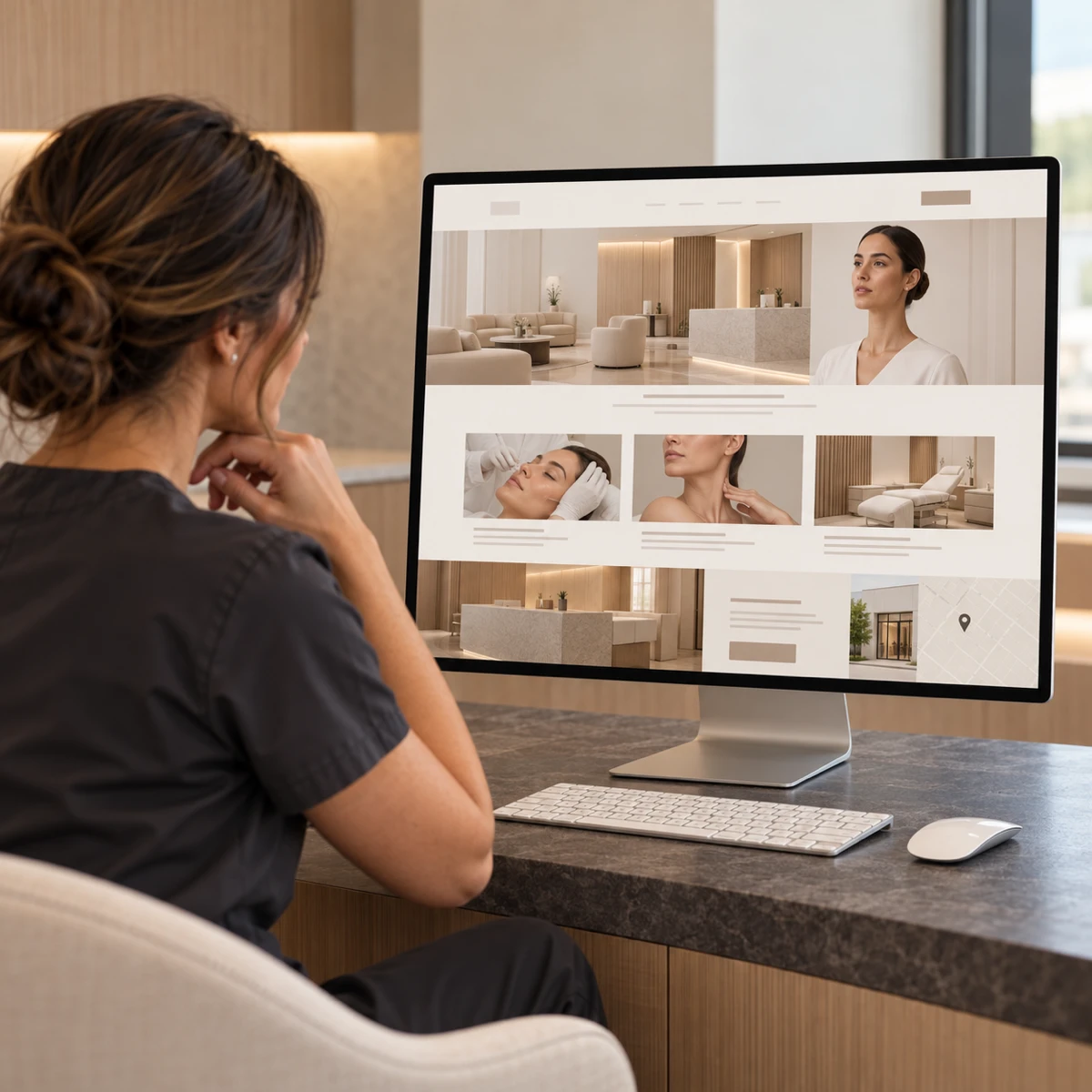
Med spa owner and website strategist reviewing a custom medical aesthetics website
Med Spa Website Design

Med Spa Website Design Built for Search and Patient Growth

Your website should be one of the hardest-working parts of your marketing system. It should help your practice compete locally, support priority treatments, present providers credibly, and turn qualified interest into consultation opportunities.

We design med spa and plastic surgery websites around treatment discovery, provider trust, local search visibility, mobile usability, and clear consultation pathways.

  • Designed for medical aesthetics
  • Built on an SEO-ready structure
  • Planned for treatments and locations
  • Focused on patient trust and action
Your practice

Is Your Website Supporting the Practice You Are Building?

Med spa owners invest in providers, technology, training, facilities, and marketing. The website should support that investment instead of creating another limitation.

An underperforming website may make it difficult to add new treatments, support multiple locations, explain provider expertise, preserve search visibility, or understand which marketing channels generate inquiries.

From the prospective patient’s perspective, the website still needs to answer practical questions:

  • Does this practice offer the treatment I am considering?
  • Who will perform the treatment?
  • What qualifications does the provider have?
  • What should I expect before and after the appointment?
  • Is there downtime or recovery?
  • Where is the practice located?
  • How do I request a consultation?

Those patient questions matter because they affect the owner’s larger goals: qualified consultation opportunities, stronger treatment visibility, provider trust, and a website that can support continued growth.

Med spa owner reviewing her practice website on a mobile phone
Presentation

Your Website Should Feel as Considered as Your Practice

Medical aesthetics is a visual field, so presentation matters. The website should reflect the care, quality, and positioning of the practice without becoming difficult to use.

A luxury appearance alone is not enough. The site also needs readable content, intuitive navigation, fast mobile access, credible provider information, and clear consultation options.

The goal is not to force a practice into a generic beauty template. The goal is to build a digital experience that feels consistent with the actual practice and gives prospective patients the confidence to continue.

Custom medical spa website displayed on a desktop computer
Definition

What Is Med Spa Website Design?

Med spa website design is the planning, content organization, visual design, and development of a website for a medical aesthetics practice.

An effective website should help prospective patients discover treatments, understand the practice, evaluate providers, find the correct location, and request a consultation. It should also give search engines a clear structure for understanding those treatments, providers, locations, and relationships.

Top Medspa Marketing designs websites for medical spas, plastic surgery practices, aesthetic clinics, and related wellness businesses. Each site is planned around the practice’s actual services, market, providers, patient journey, and growth priorities.

Scope

What Is Included in Med Spa Website Design?

01

Website Strategy and Page Planning

We begin by identifying the treatments, providers, locations, audiences, trust elements, conversion actions, and content priorities the website needs to support.

The page plan may include a homepage, treatment categories, individual treatment pages, provider profiles, location pages, galleries, financing information, educational resources, and consultation pages. The final structure should reflect the real business rather than an arbitrary page package.

02

Patient-Focused Navigation

Some visitors know the exact treatment they want. Others only know the concern they want to address.

We plan menus, page relationships, internal links, and mobile interactions so visitors can explore by treatment, concern, provider, or location without encountering confusing paths or dead ends.

03

Custom Visual Design

Typography, color, spacing, photography, and page composition should support the practice’s positioning without hiding important information.

We use visual hierarchy to guide attention, distinguish sections, and reinforce trust. The design should feel intentional and distinctive while remaining readable, accessible, and easy to use.

04

Treatment and Provider Page Frameworks

Treatment pages should answer meaningful questions instead of repeating manufacturer descriptions. Provider pages should contain verified information about credentials, background, treatment focus, locations, and care philosophy.

These frameworks help patients understand both the treatment and the person responsible for delivering it.

05

Consultation and Conversion Planning

Calls to action should match how the practice handles new inquiries. Depending on the business, that may include requesting a consultation, calling, booking online, asking a question, or exploring financing.

Forms and booking pathways should remain clear on mobile devices and should request only the information needed for the next step.

06

Analytics and Launch Preparation

We plan measurement around meaningful actions such as calls, forms, booking clicks, consultation requests, and campaign landing pages.

Before launch, agreed tracking, forms, links, mobile behavior, redirects, metadata, and crawl controls should be reviewed and tested.

Search foundation

Built for SEO First

SEO should not be added after the visual design is finished. Search structure needs to influence the website plan from the beginning.

An SEO-ready med spa website may include:

  • Crawlable navigation
  • Logical page and URL structure
  • One clear primary topic for each page
  • Useful heading hierarchy
  • Editable title tags and meta descriptions
  • Internal links between related treatments, providers, and locations
  • Compressed images with useful alt text
  • Canonical URL controls
  • XML sitemap and robots controls
  • Redirect planning when replacing an existing website
  • Structured data that matches visible content
  • Mobile and performance review
  • Analytics and conversion tracking

A technically sound website does not guarantee rankings. It removes avoidable barriers and creates a better platform for continued med spa SEO, local optimization, content development, and authority building.

Med spa owner reviewing the structure of a search-ready practice website
Answer and AI readiness

Then Prepare the Website for AEO and GEO

Answer clarity

Answer Engine Optimization

Answer Engine Optimization makes important information easier for search and answer systems to identify.

The website should make it easy to locate direct answers about treatments, candidacy, preparation, recovery, providers, locations, cost factors, and consultation options. Clear headings, concise opening answers, supporting details, and descriptive internal links all contribute to that clarity.

AEO should not be treated as an excuse to place hundreds of generic questions on the site. The right questions belong on the pages where patients naturally need the answers.

Verification

Generative Engine Optimization

Generative Engine Optimization strengthens the signals that may help generative systems understand and verify the practice.

That can include consistent business information, provider credentials, named authors or reviewers, original practice information, appropriate sources, accurate structured data, and relevant third-party recognition.

No website design or schema type can guarantee an AI citation or recommendation. The responsible objective is to make the practice easier to discover, understand, and verify.

SEO establishes the search foundation. AEO improves answer clarity. GEO strengthens the wider verification signals around the practice.

Architecture

Website Architecture That Can Grow With the Practice

A single-location practice and a multi-location group do not need the same website structure.

For one location, the site should clearly connect the homepage, treatments, providers, location information, and consultation path. For multiple locations, the architecture may need distinct provider, treatment, review, contact, and booking information for each practice location.

The same principle applies to geographic growth. City and market pages should have a legitimate purpose and original local information. They should not be interchangeable copies with place names changed.

Planning that structure before design helps the website expand without becoming a confusing collection of disconnected pages.

Process

Our Med Spa Website Design Process

  1. 01

    Discovery and Current-State Review

    We review the practice, services, providers, locations, audience, positioning, current website, available search information, and consultation process.

  2. 02

    Website and Search Architecture

    We plan the page hierarchy, navigation, URLs, internal links, and priorities for treatments, providers, locations, and resources.

  3. 03

    Content Planning

    Each page receives a clear purpose, primary topic, required information, intended action, and relationship to other pages.

  4. 04

    Design and Development

    The visual system and reusable page components are developed around the approved architecture for both desktop and mobile use.

  5. 05

    Content Integration and Optimization

    Approved content, imagery, metadata, internal links, alt text, and appropriate structured information are added and reviewed together.

  6. 06

    Quality Assurance and Launch

    We review navigation, forms, links, mobile behavior, crawl controls, metadata, analytics, redirects, and other agreed launch requirements.

  7. 07

    Post-Launch Review

    After launch, the site should be monitored for indexing, errors, tracking accuracy, consultation behavior, and opportunities for continued improvement.

New build or redesign

Do You Need a New Website or a Website Redesign?

A new website may be appropriate for a new practice, new brand, or business without a usable existing site.

A website redesign may be more appropriate when the current site already has useful content, backlinks, rankings, or established URLs that need to be evaluated and protected.

Redesign projects require additional migration planning. Changing URLs, removing useful pages, or overlooking redirects can affect existing search visibility.

If your practice already has a website, begin with a current-state assessment before deciding what should be rebuilt, retained, consolidated, or redirected.

Med spa owner reviewing an existing practice website before a redesign decision
Practices we serve

Who Med Spa Website Design Is For

This service may be appropriate for:

  • New medical spas preparing to launch
  • Established practices replacing a limited or outdated website
  • Plastic surgery practices combining surgical and nonsurgical services
  • Aesthetic practices expanding their treatment offerings
  • Multi-location practices needing a scalable structure
  • Medical weight loss and wellness practices
  • Practices preparing for SEO, advertising, or geographic expansion

The scope should match the practice’s actual stage and priorities. A single-location launch should not be forced into the same architecture as a multi-market practice.

FAQ

Med Spa Website Design FAQs

What should a med spa website include?

A med spa website should include clear treatment information, provider details, location and contact information, consultation or booking options, trust elements, policy pages, and a logical structure for future content. The exact pages depend on the practice’s services, providers, locations, and patient journey.

Is SEO included in med spa website design?

The website should be built with an SEO-ready technical and content structure. That includes crawlability, page hierarchy, URLs, headings, metadata controls, internal linking, image optimization, structured data where appropriate, and launch safeguards. Continued SEO is a separate process involving research, content development, local optimization, authority, and measurement.

Can the website support multiple med spa locations?

Yes. The architecture can support multiple locations when each location has accurate business information, relevant providers, available treatments, clear contact or booking paths, and useful local content.

Can treatment and geographic pages be included?

Yes. Treatment and geographic page frameworks can be included in the website architecture. Each published page should have a clear purpose and original, useful content. Geographic pages should not be published as interchangeable copies.

Will a new website automatically rank in Google?

No. A technically sound and useful website provides the foundation for SEO. Rankings also depend on competition, content quality, local signals, authority, reviews, links, business history, and continued optimization.

How long does a med spa website take to design?

Timing depends on the number of pages, content requirements, branding, photography, integrations, review process, migration needs, and approval timing. A defined scope and organized content process help prevent unnecessary delays.

How much does med spa website design cost?

Cost depends on the size of the site, design requirements, content needs, functionality, integrations, location structure, and whether an existing website must be migrated. An initial assessment is needed before the appropriate scope can be defined.

Med spa owner and website strategist planning the practice’s next stage of digital growth

Build a Website That Supports the Next Stage of Growth

Your website should be more than a polished brochure. It should help prospective patients discover treatments, evaluate your providers, understand your practice, and take the next step.

Top Medspa Marketing can assess what your practice needs now, what the website should support next, and how the structure can prepare the business for SEO, AEO, GEO, advertising, and geographic growth.